
Short answer: SEO gets you ranked in Google’s blue links. AEO (Answer Engine Optimization) gets you selected as the direct answer inside AI-generated summaries. GEO (Generative Engine Optimization) gets you cited as a source inside ChatGPT, Perplexity, and Gemini responses. Philippine businesses need all three, but the right starting point depends on where your customers are already searching for you. This guide breaks down each discipline, when to use it, and how we sequence them for our own clients.
By Dominic Barrios, Bots at Work · Last updated: July 18, 2026
AEO vs SEO vs GEO at a Glance
Before we go deep, here is the one-glance comparison. This is the version we hand to Philippine business owners in their first call:
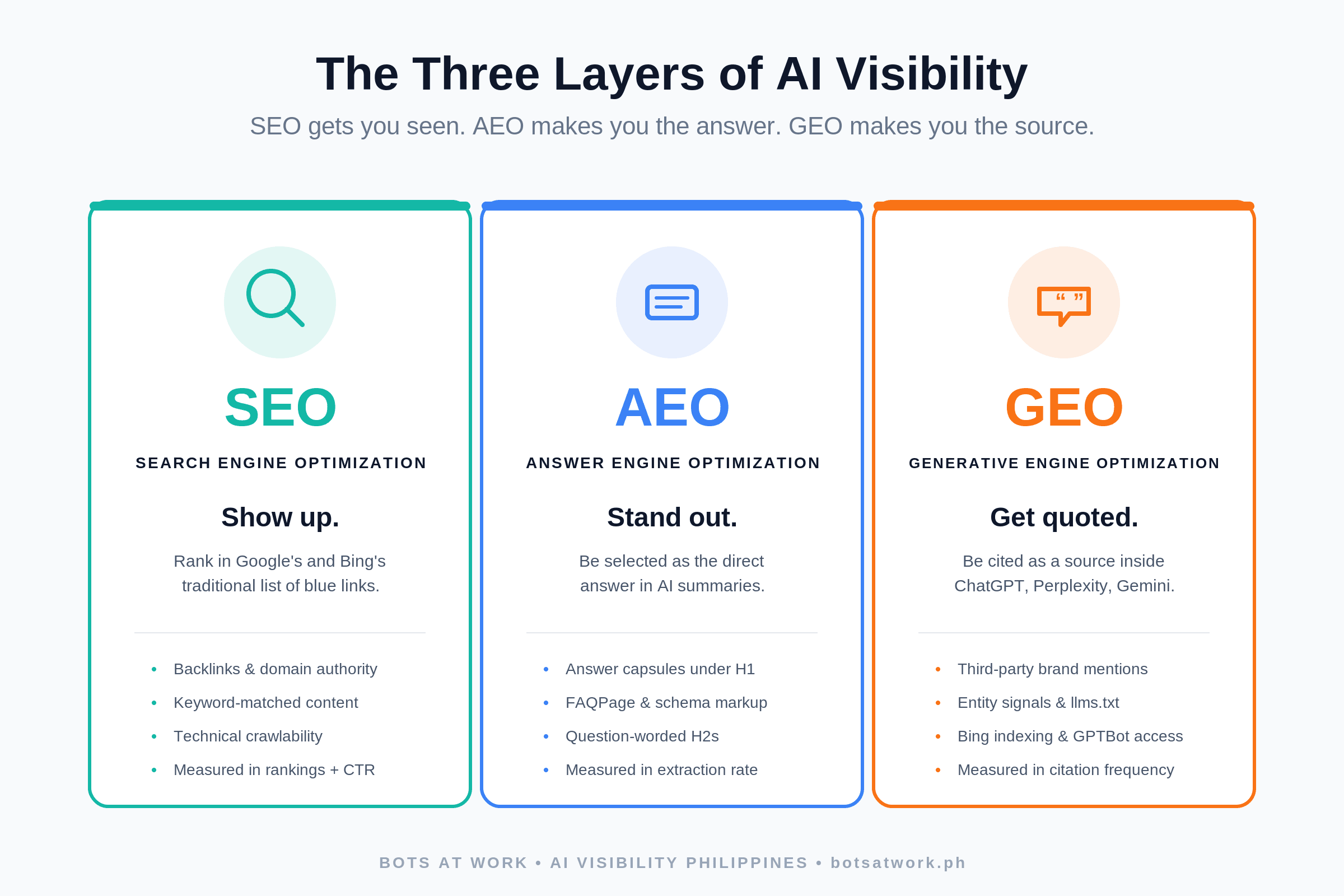
| Discipline | Full Name | Goal | Where You Show Up | Core Signal |
|---|---|---|---|---|
| SEO | Search Engine Optimization | Rank in the blue links | Google, Bing organic results | Backlinks + keyword relevance + technical health |
| AEO | Answer Engine Optimization | Become the direct answer | Featured snippets, Google AI Overviews, voice results | Structured content + schema + answer capsules |
| GEO | Generative Engine Optimization | Get cited as a source | ChatGPT, Perplexity, Gemini, Claude answers | Entity signals + third-party mentions + extractable content |
At Bots at Work we sequence all three using the V.I.S.I.B.L.E.™ Method, our own framework for running them as one system instead of three disconnected campaigns.
The simple mental model: SEO = show up. AEO = stand out. GEO = get quoted. Each maps to a different moment in how modern buyers search, and each requires slightly different work.
Why This Matters for Philippine Businesses Right Now
Search behavior in the Philippines has changed faster than most local businesses realize. Filipino buyers now split their research across three surfaces: they Google an option, ask ChatGPT to compare providers, and read the AI Overview that Google shows above the blue links. ChatGPT now has more than 200 million weekly active users worldwide, and Filipino professionals are part of that shift.
A business that only wins on Google’s blue links is still invisible on two of the three surfaces. That is the practical reason the SEO vs AEO vs GEO distinction matters: each represents a different way for your customer to discover you, and you cannot win the buyer without showing up on the surface they are actually using.
At Bots at Work, we ran a baseline audit in March 2026 across 8 Philippine queries in the AI chatbots and AI Visibility categories, measured on ChatGPT, Perplexity, and Gemini. We ranked in 17 of 24 possible positions (71%), holding the top spot in 14 of them. The results were not evenly distributed: we placed #1 on ChatGPT and Perplexity for most queries but appeared on Gemini for only 2 of 8. Winning one surface did not automatically win the others.
What Is SEO? (Search Engine Optimization)
SEO is the practice of optimizing your website to rank in Google’s and Bing’s traditional list of links. It is the oldest of the three disciplines, and it is still the foundation everything else builds on.
SEO focuses on three things: technical health (crawlability, site speed, mobile experience), on-page relevance (title tags, headings, keyword usage), and off-page authority (backlinks from other trustworthy sites). When someone types “AI chatbot Philippines” into Google, SEO decides whether your business shows up on page one, page five, or not at all.
SEO is measured in rankings, organic traffic, and click-through rate. A page that ranks #1 for a commercial keyword can drive dozens or hundreds of qualified visits per month for a Filipino SME. That traffic is the reason SEO still deserves the biggest share of most marketing budgets. For a Philippine-scoped explainer, see our AI SEO Philippines guide.
What Is AEO? (Answer Engine Optimization)
AEO is the practice of structuring your content so that AI-powered answer surfaces select it as the direct answer to a user’s question. Instead of ranking in a list, AEO wins the featured snippet at the top of Google, the paragraph inside Google AI Overviews, the voice-assistant response, and the extracted answer inside any AI feature that quotes a source.
AEO relies on three levers: answer capsules (short, direct paragraphs placed at the top of key pages), schema markup (invisible structured data that tells AI what your content is about), and question-worded headings (H2s and H3s phrased as full questions). In our own testing, pages with clean answer capsules and FAQPage schema were extracted noticeably more often than pages that lead with a company story.
AEO is measured differently from SEO. Traffic still matters, but the primary metrics are extraction rate (how often your content is quoted), share of voice inside AI answers, and citation frequency across specific queries. For the full playbook, see our Answer Engine Optimization Philippines guide.
What Is GEO? (Generative Engine Optimization)
GEO is the practice of getting your brand cited as a source inside AI-generated responses on ChatGPT, Perplexity, Gemini, and Claude. Each platform documents its own crawler behaviour, such as the Perplexity Crawlers documentation. Where AEO is about winning a single answer box, GEO is about becoming a trusted entity that large language models remember and recommend across many different queries.
GEO leans harder on off-site signals than on-page ones. Language models trust entities that multiple independent sources talk about — directories, review sites, industry press, LinkedIn, expert quotes. Building this “web of mentions” is what makes an AI system associate your business with your category, so that when a user asks a fresh question in that category, your name is one of the sources it pulls.
GEO also depends on llms.txt, an emerging convention that lets you provide a curated table of contents specifically for large language models, and on entity-level schema (Organization, Person, sameAs) that verifies who you are across the web. For our Philippine-focused GEO playbook, see the Generative Engine Optimization Philippines guide.
AEO vs SEO vs GEO: The Complete Comparison
Here is the full head-to-head. Print this and put it above your desk if you plan to explain this to a boss or a client:
| Factor | SEO | AEO | GEO |
|---|---|---|---|
| Optimizes for | Search engines (Google, Bing) | Answer engines (AI Overviews, snippets, voice) | Generative engines (ChatGPT, Perplexity, Gemini) |
| Output format | Ranked list of links | Single extracted answer | Synthesized response citing 2–5 sources |
| Primary signal | Backlinks, keyword match, domain authority | Answer capsules, FAQ schema, question H2s | Entity mentions, third-party citations, llms.txt |
| Content style | Comprehensive, keyword-optimized | Direct, structured, question-first | Original insight, quotable, entity-rich |
| User behavior | Clicks a link, visits your site | Reads the answer, may or may not click | Reads the AI response, may never click anything |
| Data source AI uses | N/A | Google index + schema | Bing index + training data + real-time web |
| Time to first result | 3–6 months | 4–8 weeks | 30–90 days |
| Measurement | Rankings, traffic, CTR | Extraction rate, snippet ownership | Citation frequency, share of voice |
| PH competition (2026) | Moderate to high | Low | Low |
| Best analogy | Get in the phone book | Be the featured business inside | Be the friend a knowledgeable local recommends |
Where Should Philippine Businesses Start?
The right sequence depends on where you are now. Here is the decision framework we use with clients at Bots at Work:
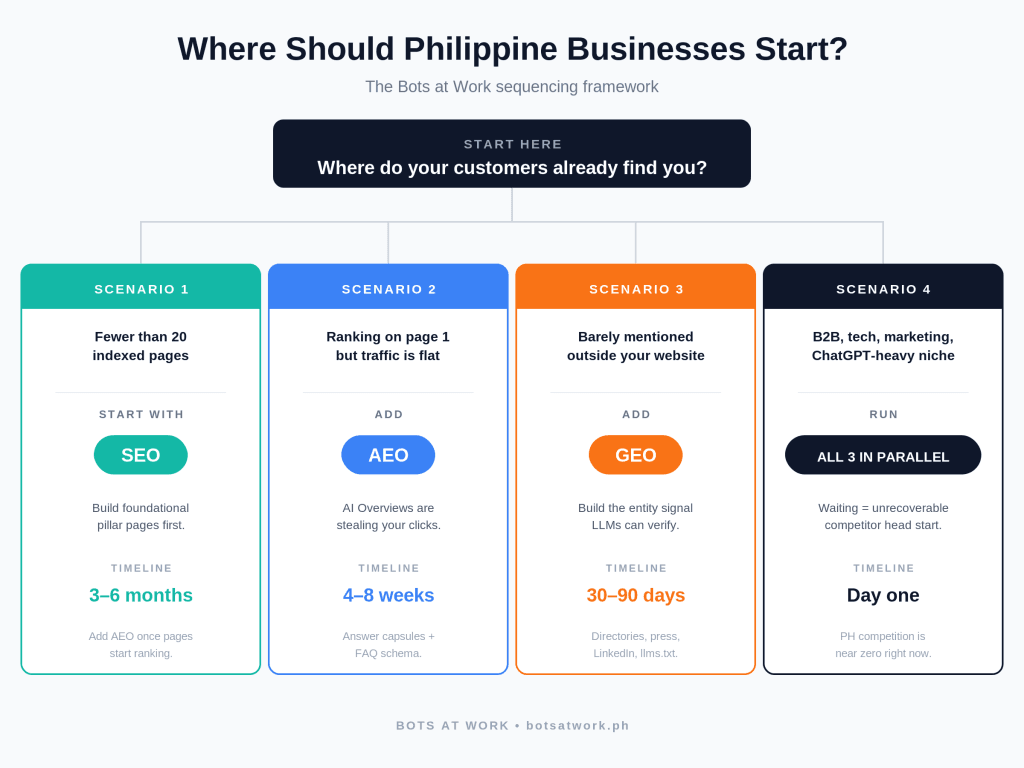
- If your website has fewer than 20 pages of indexed content, start with SEO. There is no answer to extract from a site that Google barely knows exists. Build foundational SEO first: crawlability, on-page targeting, and a handful of pillar pages.
- If you already rank on Google’s first page for some queries but see zero traffic growth, add AEO. Google’s AI Overviews are cannibalizing the clicks. Restructure your existing top-ranking pages with answer capsules and FAQ schema so you become the extracted source instead of losing the click.
- If your brand is barely mentioned outside your own website, add GEO. A business with only its own site is nearly impossible for a language model to verify. Invest in directories, LinkedIn presence, industry press, and quoted-expert opportunities to build the entity signal.
- If you sell to a niche where ChatGPT already drives buying decisions (B2B services, AI, marketing, tech, health) — run all three in parallel from day one. Waiting three months to add AEO or GEO gives competitors an unrecoverable head start.
For most Philippine SMEs we work with, the practical order is: SEO first for 60 days, then AEO layered onto the top-ranking pages, then GEO started in parallel once there is enough on-page content to be worth citing. Nobody needs to wait until “SEO is finished” to start on AEO or GEO — the disciplines overlap and reinforce each other.
How to Optimize for All Three at Once
The good news is that these disciplines share more than they differ. If you do the following six things, you are simultaneously moving the needle on SEO, AEO, and GEO:
- Add an answer capsule under every H1. A 40–80 word direct answer to the page’s target question. Helps SEO (dwell time), AEO (extraction), and GEO (quotability).
- Use question-worded H2s and H3s. “How much does an AI chatbot cost in the Philippines?” outperforms “Cost breakdown” for all three disciplines.
- Add FAQPage, Organization, and LocalBusiness schema. These pieces of structured data are read by Google (SEO/AEO) and by AI crawlers building their entity graphs (GEO).
- Publish original data, examples, or opinions. Aggregators lose. Original sources get quoted across all three surfaces.
- Get mentioned on third-party sites. Backlinks help SEO, brand mentions help GEO, and both signal authority to AEO.
- Submit to Bing Webmaster Tools and allow AI crawlers (GPTBot, OAI-SearchBot, ChatGPT-User) in robots.txt. Without this, ChatGPT literally cannot see your site. See our Get Found in ChatGPT Philippines guide for the exact configuration.
What About LLM SEO? Where Does It Fit?
You may also see the term LLM SEO (Large Language Model SEO). Some practitioners use it interchangeably with GEO. We use it more narrowly: LLM SEO refers specifically to platform-level optimization for individual language models — the technical work of getting cited by ChatGPT as opposed to Perplexity, or by Gemini as opposed to Claude, each of which has its own crawler behavior and citation logic.
The umbrella term that captures all four disciplines — SEO, AEO, GEO, and LLM SEO — is AI Visibility. That is how we describe the full package to clients:
| Term | What It Optimizes For |
|---|---|
| SEO | Traditional search rankings |
| AEO | AI answer boxes and featured snippets |
| GEO | Citations inside generative AI responses |
| LLM SEO | Platform-specific optimization for individual LLMs |
| AI Visibility | All four, treated as one system |
For the pillar overview of how these disciplines combine, see our AI Visibility Philippines pillar page.
What Bots at Work Learned Running All Three
We tested every part of this framework on our own business first. Bots at Work now appears in ChatGPT, Perplexity, and Google AI Overviews for a growing list of Philippine AI chatbot and AI Visibility queries — but the wins came in a specific order, and understanding that order is more valuable than the individual tactics.
SEO gave us the first traffic. Ranking on Google’s first page for “AI chatbot Philippines” and “AI chatbot for business Philippines” fed the pipeline with organic inquiries. That took roughly four months of consistent publishing.
AEO gave us the AI Overview citations. Once we restructured our top-ranking pages with answer capsules and FAQ schema, Google’s AI Overview began quoting botsatwork.ph directly for definitional queries. The citations followed the schema push rather than preceding it, which is the sequence we now expect.
GEO gave us the ChatGPT and Perplexity citations. Those came last, and required both Bing Webmaster Tools submission and consistent third-party mentions across LinkedIn, industry pieces, and directories. Perplexity moved fastest of the three because it searches the live web in real time, while ChatGPT lagged behind it. Plan for 30 to 90 days on both. The full walkthrough is in our AI Visibility Case Study Philippines.
The most important observation from that baseline: our weakest platform was Gemini, where we surfaced on only 2 of 8 queries despite holding #1 on ChatGPT and Perplexity for most of the same set. Strength on one AI surface tells you very little about the others, which is exactly why AI Visibility has to be measured per platform rather than as a single score.
Frequently Asked Questions
Is AEO replacing SEO?
No. AEO extends SEO — it does not replace it. Every AEO tactic assumes your site is already indexed, crawlable, and reasonably authoritative in the classic SEO sense. Google AI Overviews and ChatGPT both use search engine indexes as one of their inputs, so a site that has been abandoned by SEO cannot succeed at AEO either.
Is GEO the same as AEO?
No. AEO targets answer boxes on traditional search engines (featured snippets, voice results, Google AI Overviews). GEO targets citations inside generative AI systems (ChatGPT, Perplexity, Gemini, Claude). The disciplines overlap on content structure but diverge sharply on off-site signals — GEO depends far more heavily on brand mentions across independent sources than AEO does.
Do I need to do all three?
For most Philippine businesses in 2026, yes. Buyers now split their research across Google’s blue links, Google’s AI Overview, and ChatGPT within the same session. A business that wins one and loses the other two still loses the buyer. The good news is that the six practices in the “How to Optimize for All Three” section above move all three metrics at once, so the incremental effort is smaller than running three separate campaigns.
How much does an AI Visibility (AEO plus GEO) service cost in the Philippines?
Pricing varies with scope. Our AI Visibility retainers for Philippine businesses run in four tiers from ₱15,000 to ₱50,000 per month: monitoring only at the entry tier, monitoring plus content at ₱25,000, content-led work at ₱40,000, and full management at ₱50,000. Most businesses start with a ₱25,000 AI Visibility audit, which is credited toward the first month of a retainer. For context on why the range is wide, see our AI chatbots and AI Visibility FAQ.
How long before I see results?
SEO wins are the slowest — three to six months to establish rankings for competitive keywords. AEO is fastest — new snippet or AI Overview inclusions can appear within four to eight weeks of a structured content push. GEO citation in ChatGPT typically shows up 30 to 90 days after Bing submission and consistent third-party mentions. If someone promises you overnight ChatGPT citations, they are guessing.
What is an answer capsule?
An answer capsule is a short paragraph, usually 40 to 80 words long, placed directly under your H1 heading that answers the page’s target question in plain language. It is one of the most reliable predictors of AI extraction across ChatGPT, Google AI Overviews, and Perplexity. Every well-optimized AEO page opens with one — including this article.
Do these disciplines work for Filipino-language queries?
Partially. English-language queries dominate Philippine business research even for Filipino audiences, and AI Overviews trigger far more often for English queries. Tagalog and Taglish AI search behavior is developing but immature. For 2026, English-first content with occasional Taglish phrases performs best across all three disciplines.
Should Philippine businesses hire an agency for this?
The basics — Bing Webmaster Tools submission, GPTBot allowlisting, FAQ schema, Google Business Profile — can be done in-house by any owner with basic WordPress skills. The ongoing work of tracking citation across four AI platforms, maintaining content clusters, and building third-party mentions is where most SMEs choose to outsource. If you want to see exactly where your business appears (and does not) across ChatGPT, Perplexity, Gemini, and Google AI Overviews, that is where a specialist agency earns its fee.
Ready to Get Your Philippine Business Cited by AI?
The Philippine market has a rare, closing window in 2026. Most Filipino SMEs are still almost entirely invisible in AI answers, so the businesses that show up in ChatGPT, Perplexity, and Google AI Overviews right now are reaching buyers before their category gets crowded.
If you want to see exactly where your business appears — and where it does not — across every AI surface, start with a free visibility audit.
Book a Free AI Visibility Audit →
About Bots at Work
Bots at Work is an AI Visibility agency that helps Philippine businesses appear in AI-generated answers on ChatGPT, Perplexity, and Gemini — not just on traditional Google. Founded by Dominic Barrios, the company applies SEO, AEO, GEO, and LLM SEO strategies proven on its own business before recommending them to clients. Bots at Work operates out of Ortigas Center, Pasig, and serves businesses in the Philippines and internationally through botsatwork.ph. To learn how AI Visibility can get your business cited by AI models, visit botsatwork.ph/contact-us.